


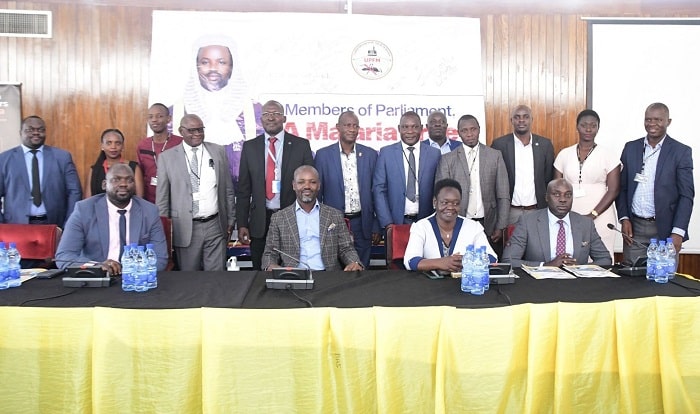
Legislators of the Uganda Parliamentary Forum on Malaria (UPFM) have asked the Government to consider investing more money in genetic research and pharmaceuticals in the fight against malaria.
The MPs say technologies like the use of gene drive mosquitoes to complement the already existing eradication tools have the potential to completely eliminate malaria and therefore the research should be adequately funded.
“We urge the Government to invest massively in research: research being done in the genetic area and the pharmaceutical area should be adequately financed if we are to fight against malaria and achieve zero malaria in Uganda,” The UPFM Chairperson, Timothy Batuwa (Jinja City West) said.
The MPs are now saying that if Uganda is to achieve the Zero Malaria by 2030 target, there is a need to advocate for more health financing into genetic research and other scientific interventions with the potential to alienate the malaria epidemic.
World Health Organization (WHO) and the Ministry of Health (MoH) held a dialogue on malaria with Members of Parliament under their umbrella body, Uganda Parliamentary Forum on Malaria (UPFM) in May 2023.
The dialogue under the theme “The role of the Eleventh Parliament in making malaria elimination priority: the critical importance of reaching marginalized populations with the tools and strategies that are available” aimed at raising awareness among UPFM members, and decision-makers about the critical need to reach everybody, with the available tools and strategies to fight malaria
The goal is to show commitment and renew the efforts of eliminating malaria in Uganda alongside other ongoing Government interventions like Indoor Residual Spraying (IRS), larviciding, and the distribution of treated mosquito nets.
The Deputy Speaker, Thomas Tayebwa has said that policymakers and politicians are one of the biggest drivers who will fight to eliminate malaria in Uganda.
Malaria remains a public health concern, challenging several developing countries in Africa that has left millions dead, families impoverished, and a significant burden to human capital development.
According to a 2022 World Health Organisation (WHO) World Malaria Report, Uganda is the 3rd leading contributor of malaria cases (5%) and 7th contributor to global malaria deaths, a trajectory that lawmakers think can be changed if the Government embraced massive investment in genetic research.
WHO estimates that at least 44.2% of Uganda’s population is at risk of catching malaria, the majority being children under 5 years, expectant mothers, and persons living with HIV/AIDs.
These, according to the report, cannot afford malaria treatment which is estimated to cost roughly US$ 9 (Shs 32,000) per episode of malaria.
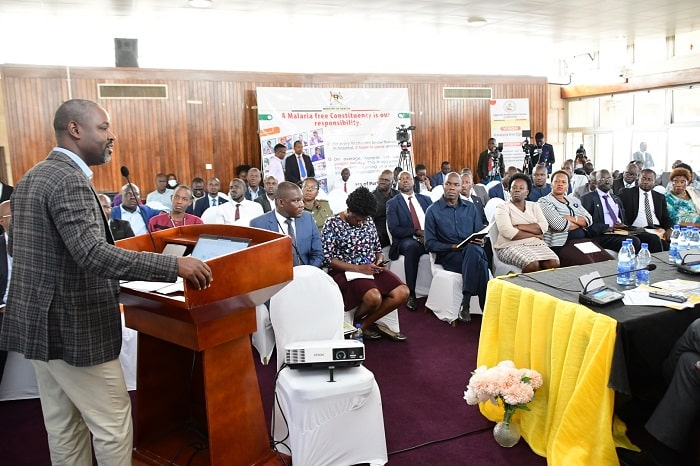
Tayebwa who is also the patron of the(UPFM) on Malaria made these remarks at a National Dialogue on malaria at Parliament on Wednesday, 03 May 2023.
Tayebwa said that Uganda is ranked number three in contributing to the highest rate of malaria cases after Nigeria and the Democratic Republic of Congo in sub-Saharan Africa.
He added that the fight against malaria cannot be on Parliament alone if mass sensitization of people in areas with high malaria prevalence is to be successful.
He expressed concern over malaria funding as established from the statistics where the Government of Uganda was only contributing to two per cent of the overall budget.
“How many of you here are in the Budget Committee and have taken advantage during appropriation since the Minister of Health does not sit in that committee?” he asked adding, ’ See the disparity in funding for a disease that wrecks our health system year in and year out. It’s worrying,” said Tayebwa.
The current budget appropriation from Parliament is US$6 m, US$ 219 m from the Global Fund and US$264m from partners.
Tayebwa also cautioned members who are causing political interference in technical matters and asked them to respect science, which he says provides all the necessary tools for more research work on malaria prevention and elimination.
Tayebwa called for more sensitization efforts to mobilize communities to join the fight against malaria. “Let us sensitize our people to stop using mosquito nets for fishing, harvesting coffee, making a local brew, and trapping grasshoppers. Others use nets as mattresses. This must stop. If residual spraying has worked in other communities, leaders should not stand in its way when it comes to their communities,” he said.
Tayebwa observed that fighting malaria doesn’t have to be about the amount of money available, but instead embracing the basic strategies such as clearing bushes around homes. “Let us use plants in our homes that are mosquito repellents. As leaders, we must combine efforts and kick malaria out of Uganda and save lives by ensuring that our people take the basic prevention measures such as draining stagnant water, and clearing bushes, as laid out by the Ministry of Health and the World Health Organization,” he added.
Dr. Jimmy Opigo, the Assistant Commissioner in charge of the National Malaria Control Division at MoH noted that Uganda has continued to record an upsurge of malaria cases, especially in Karamoja, Acholi, and Bukedea Sub-regions despite different government interventions to contain the disease. He urged the Members of Parliament to embrace MoH programs aimed at fighting malaria and advocate for more funding for the cause. “On World Malaria Day, we rolled out distribution of insecticide treated bed nets, and this exercise will soon be extended to parishes across Uganda. We urge leaders to work with us and ensure the nets are well distributed, and used by people in their respective communities,” he said.
Dr. Charles Katureebe, the Malaria Advisor at WHO Uganda asked members of the forum to include malaria among the other 19 neglected tropical diseases and called for political commitment at all levels to ensure a successful fight against the disease. “We need to have mass action against malaria where control is everyone’s responsibility, at all levels,” he said. “We need to break down the slogan ‘A Malaria-free constituency is our responsibility’ to all levels of the constituency to ensure all leaders at schools, factories, and churches work towards malaria-free communities under their care.
He said that a mass action approach against malaria and political commitment from national to village levels is the way to eliminate malaria in Uganda.
Ends
